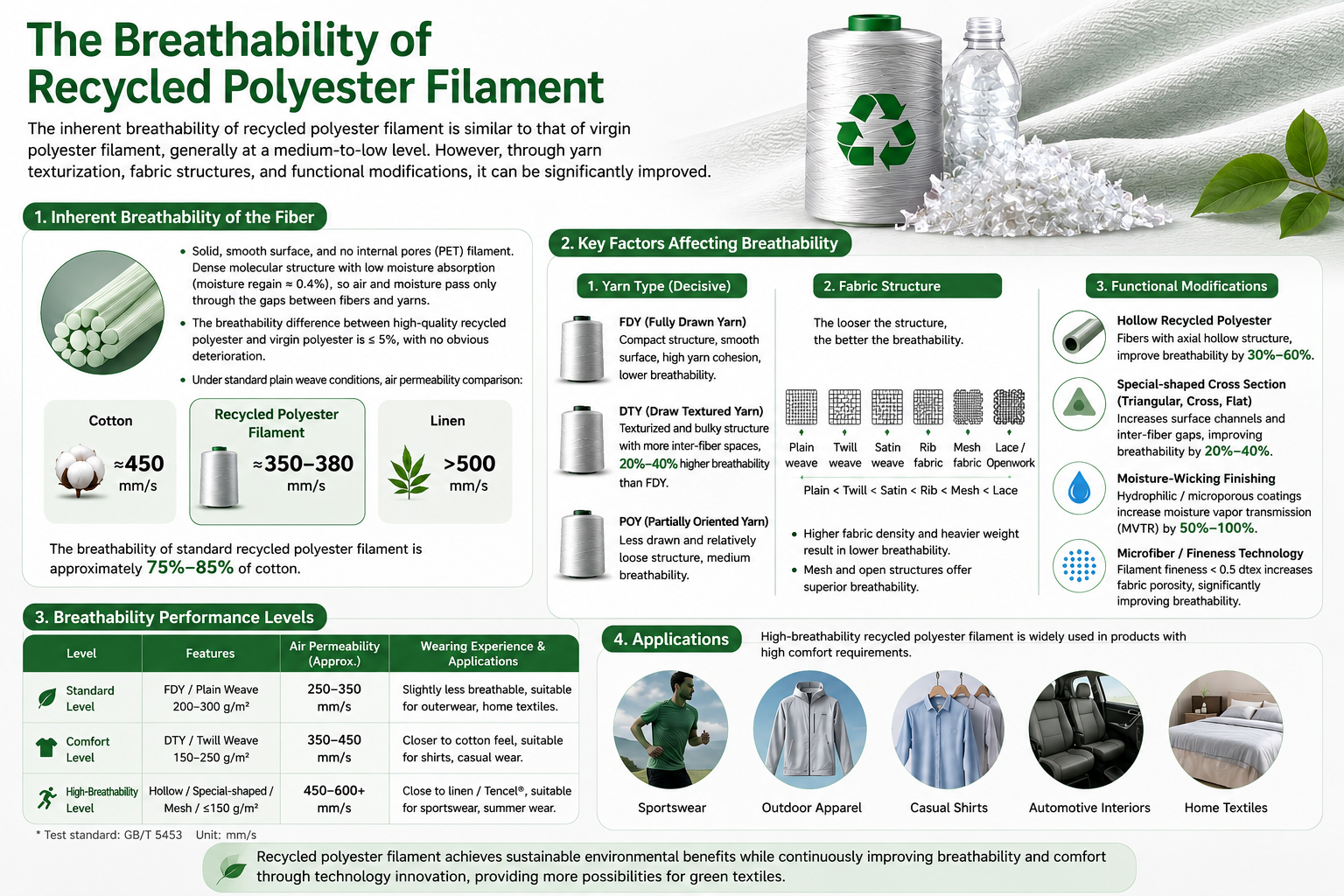
The breathability of recycled polyester filament is generally similar to that of virgin polyester filament, falling into a medium-to-low breathability level overall. Due to the dense molecular structure, smooth fiber surface, and low moisture absorption of polyester, air and moisture mainly pass through the gaps between fibers and fabric structures rather than through the fibers themselves. As a result, its natural breathability is lower than cotton, linen, and other natural fibers.
Under similar fabric conditions:
The breathability of standard recycled polyester filament is approximately 75%–85% that of cotton.
However, the final breathability of recycled polyester fabrics depends not only on the material itself, but also on yarn structure and fabric construction.
DTY is especially suitable for sportswear, knitted fabrics, and casual apparel.
Fabric structure has a major impact on airflow:
Plain weave < Twill weave < Satin weave < Mesh structures
In general:
will reduce breathability.
Advanced textile technologies can significantly improve the comfort performance of recycled polyester.
| Grade | Features | Air Permeability |
|---|---|---|
| Standard Grade | FDY / Plain weave | 250–350 mm/s |
| Comfort Grade | DTY / Twill weave | 350–450 mm/s |
| High-Breathability Grade | Hollow / Mesh / Special-shaped fibers | 450–600+ mm/s |
High-breathability recycled polyester fabrics can already achieve comfort levels close to linen and premium sportswear fabrics.
Overall, recycled polyester filament does not naturally offer the same breathability as cotton or linen. However, through DTY texturing, hollow structures, special cross-sections, and moisture-management finishes, its comfort and breathability can be greatly improved.
Today, high-performance recycled polyester not only provides sustainability benefits, but is also increasingly used in sportswear, outdoor textiles, summer apparel, and functional fabric applications.

Be the first to get our latest styles and offers.
Room 1502-1,1502-2,15th Floor,NO.3199 South Jiefang Road,Jianhu Street,Yuecheng District, Shaoxing City, Zhejiang Province,China
Copyright © 2024 SHAOXING SHENMARK TEXTILE TECHNOLOGY CO.,LTD
 EN
EN
 AR
AR FR
FR DE
DE HI
HI IT
IT JA
JA KO
KO RU
RU ES
ES TL
TL ID
ID VI
VI TH
TH TR
TR MS
MS UR
UR BN
BN KM
KM LO
LO NE
NE MY
MY KU
KU KY
KY